Comparison
Ram ProMaster Payload, GVWR and Wheelbase by Year, 2020–2027
ProMaster payload, GVWR, trailer rating, wheelbase, roof height, cargo volume and fluids by year, plus how the smaller ProMaster City compares.
By the West CDJR editorsUpdated November 8, 20268 min read
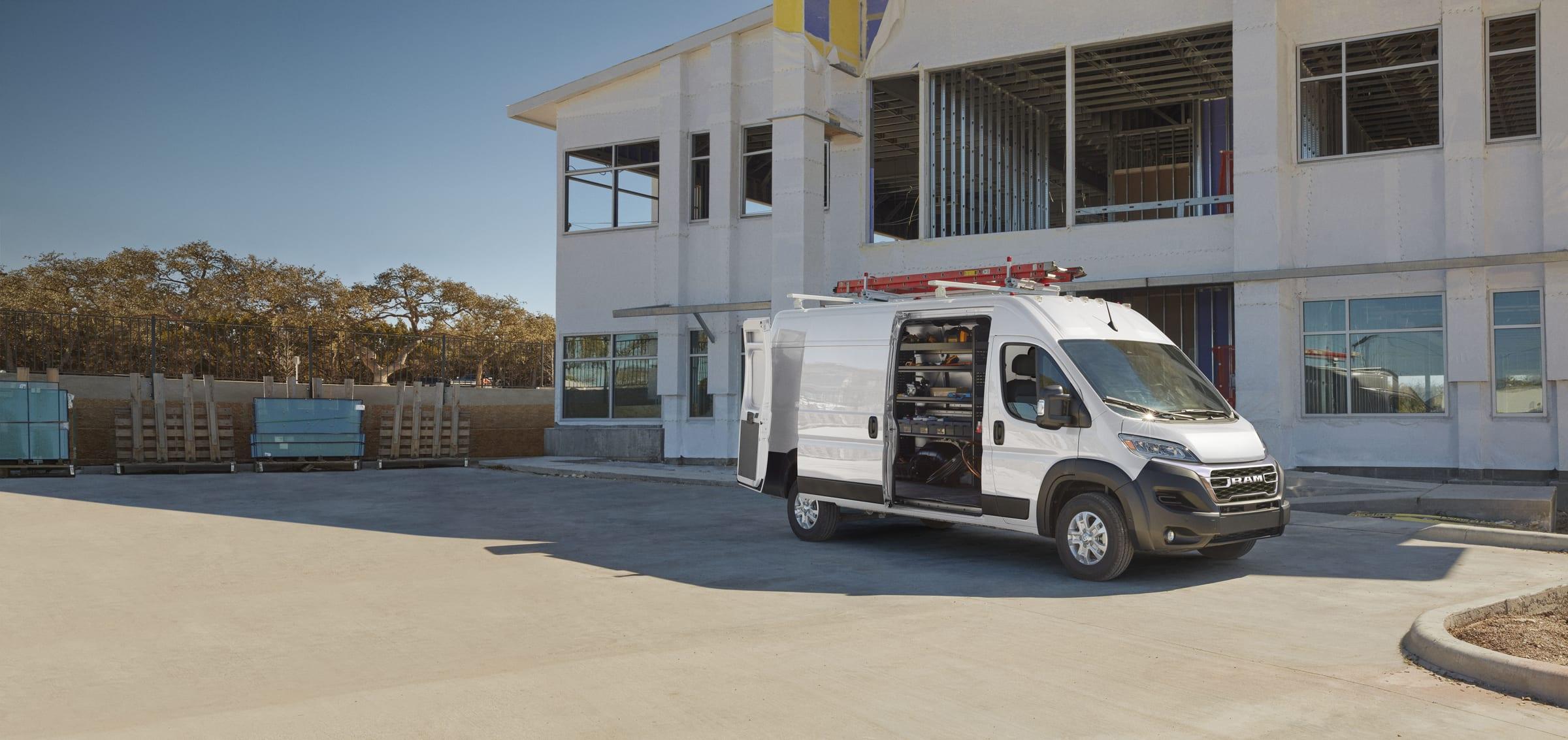
A contractor in Phoenix, Las Vegas, Denver or Los Angeles asking "what does a ProMaster 2500 actually carry?" gets three different answers depending on the year, the wheelbase and the roof. This page pulls the factory numbers year by year from our research database: payload and GVWR from the manufacturer's tow charts (2020 through 2026), wheelbase, roof height and cargo volume from the spec sheets, and oil, coolant and fuel-tank capacities from the owner's manuals.
Short answers first. Across 2020 to 2026 the ProMaster's GVWR is 8,550 lb on the 1500, 8,900 lb on the 2500 and 9,350 lb on the 3500 (the 2022 chart lists none). Cargo-van payload ranges from 3,760 lb to 4,820 lb over those years, and the cutaway reaches 5,350 lb. The data has no 2027 ProMaster tow chart or spec sheet, and no diesel after 2018.
GVWR and payload by model and year
In every chart row that lists both weights, payload equals GVWR minus curb weight to within 5 lb. For example, the 2026 3500 cargo van on the 136‑inch wheelbase has a 9,350 lb GVWR and a 4,604 lb curb weight; the difference is 4,746 lb, and the chart lists 4,750 lb. The table gives the low and high payload across every configuration of each model.
| Year | 1500 payload, lb | 2500 payload, lb | 3500 payload, lb |
|---|---|---|---|
| 2020 | 3,760 to 4,000 | 3,940 to 4,260 | 4,290 to 5,230 |
| 2021 | 3,760 to 4,000 | 3,940 to 4,260 | 4,290 to 5,230 |
| 2022 | 3,800 to 4,010 | 3,950 to 4,260 | 4,270 to 5,250 |
| 2023 | 3,800 to 4,010 | 3,950 to 4,260 | 4,190 to 5,220 |
| 2024 | 3,800 to 4,150 | 4,000 to 4,400 | 4,300 to 5,350 |
| 2025 | 3,800 to 4,160 | 4,000 to 4,400 | 4,300 to 5,350 |
| 2026 | 3,870 to 4,080 | 4,020 to 4,320 | 4,260 to 5,280 |
The top of each range is a low-roof or cutaway configuration, and the bottom is a high-roof, longer or window-van body. The 2024 chart is the first to lift the 1500 and 2500 ceilings (4,150 and 4,400 lb, up from 4,010 and 4,260 in 2023), and the 2026 chart gives some of that back.
Here is how six common configurations moved. "H1" is the chart's code for low roof and "H2" for high roof, per the 2022 spec sheet's "Height category" column.
| Configuration | 2020 | 2022 | 2023 | 2024 | 2025 | 2026 |
|---|---|---|---|---|---|---|
| 1500 cargo, 118-in wheelbase, H1 | 4,000 | 4,010 | 4,010 | 4,150 | 4,160 | 4,080 |
| 1500 cargo, 136-in, H2 | 3,760 | 3,800 | 3,800 | 3,800 | 3,800 | 3,870 |
| 2500 cargo, 136-in, H1 | 4,260 | 4,260 | 4,260 | 4,400 | 4,400 | 4,320 |
| 2500 cargo, 159-in, H2 | 4,010 | 4,000 | 4,000 | 4,000 | 4,000 | 4,070 |
| 3500 cargo, 136-in, H1 | 4,680 | 4,680 | 4,680 | 4,820 | 4,820 | 4,750 |
| 3500 cutaway, 159-in, H1 | 5,200 | 5,220 | 5,220 | 5,350 | 5,350 | 5,280 |
Two cautions. First, the 2026 chart lists the 3500 cargo van on the 159‑inch wheelbase in high roof twice, at 4,500 lb and 4,390 lb, with different curb weights, and no row for the extended-body high roof that appeared in 2025 (4,320 lb). Treat those two rows as a labeling puzzle and check the door sticker. Second, 2021 repeats 2020 exactly, and 2023 repeats 2022's payloads for most rows, so the real steps are 2022, 2024 and 2026.
Maximum trailer weight and combined weight
| Year | 1500 trailer, lb | 2500 trailer, lb | 3500 trailer, lb |
|---|---|---|---|
| 2020 to 2023 | 6,700 to 6,910 | 6,480 to 6,800 | 5,100 to 6,700 |
| 2024 and 2025 | 6,700 to 6,910 | 6,480 to 6,800 | 5,600 to 6,700 |
| 2026 | 6,700 to 7,130 | 6,480 to 7,020 | 5,600 to 7,500 |
The charts list a 12,000 lb GCWR for the cargo and window vans every year. The cutaway and chassis cab rows show 11,500 lb in 2020, 2021 and 2024 to 2026 (the 2026 136‑inch cutaway is listed at 12,000 lb) and 12,000 lb in 2022 and 2023. That 2026 136‑inch cutaway also carries the 7,500 lb trailer figure, the highest in the table; the 159‑inch cutaway in the same year is 5,600 lb.
Wheelbase, roof height and cargo volume
The 2023 to 2026 configuration data and the 2020 to 2022 spec sheets agree on volumes (cargo volume appears in the 2020, 2021 and 2022 sheets) but differ on height and length by up to a few inches.
| Body | Wheelbase, in | Length, in (2023 to 2026) | Height, in (2023 to 2026) | Height, in (2020 to 2022 sheet) | Cargo volume, cu ft |
|---|---|---|---|---|---|
| Low roof, short | 118 | 195.4 | 91.7 | 91.7 | 259 |
| Low roof | 136 | 213.2 | 93.0 | 92.8 | 304 |
| High roof | 136 | 213.2 | 103.6 | 105.9 | 353 |
| High roof | 159 | 236.2 | 102.1 | 105.9 | 420 |
| High roof, extended body | 159 | 250.6 | 102.5 | 105.9 | 463 |
| Super high roof, extended | 159 | 250.6 | not listed | not applicable | 463 listed |
| Cutaway or chassis cab | 136 and 159 | 213.2 to 250.6 | 87.3 | 88.2 (136-in), 87.3 (159-in) | none |
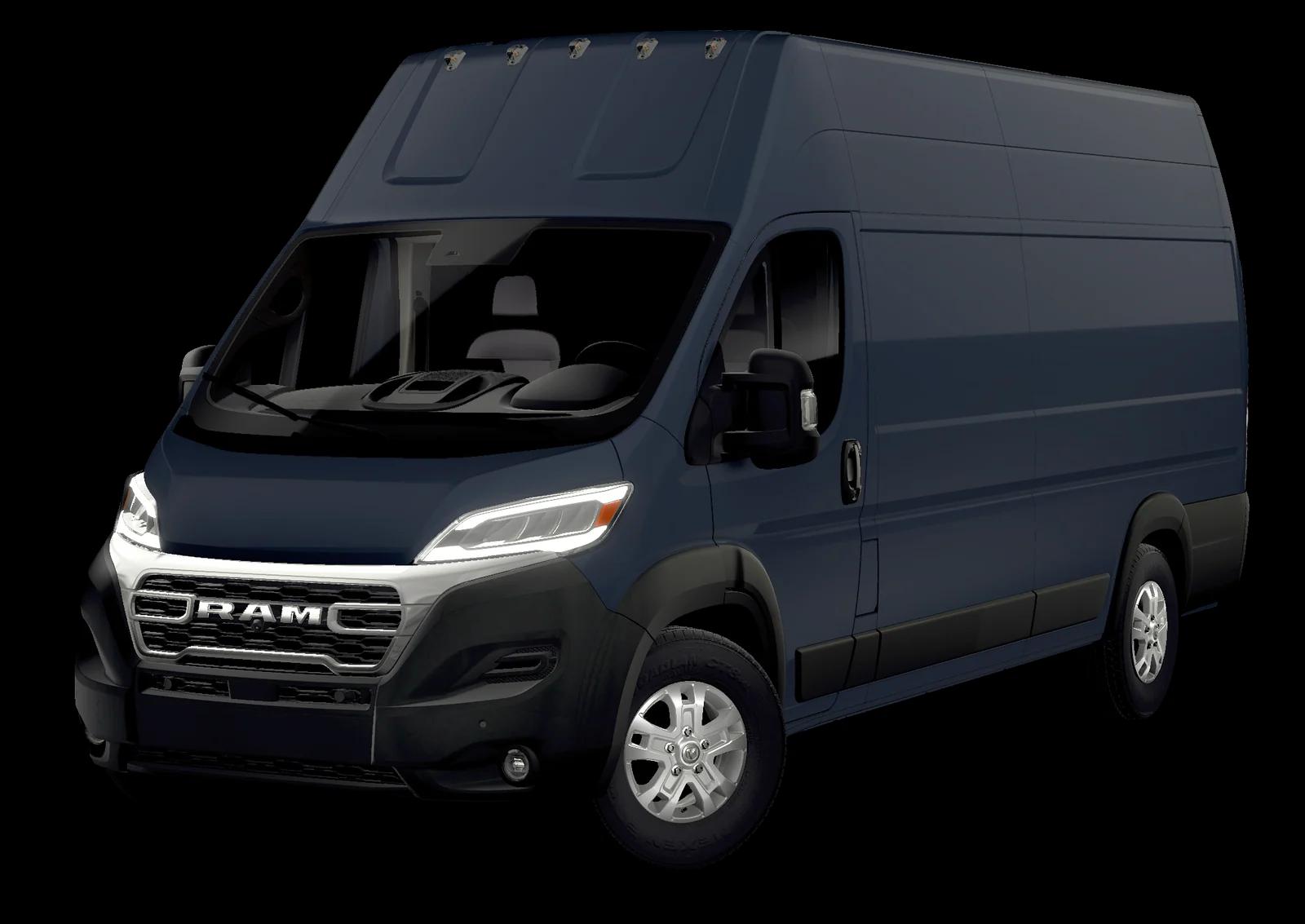
The high roof is 10.6 in taller than the 136‑inch low roof by subtraction (103.6 minus 93.0), and the interior cargo height in the data is 76.0 in against 65.4 in for the low roof, which is the same 10.6 in. The older sheets give 105.9 in for every high roof, which is 2.3, 3.8 and 3.4 in more than the newer 103.6, 102.1 and 102.5 figures. The files do not say whether the van changed or the measurement method did. The super-high-roof 3500 appears in the configuration lists for 2023 to 2026. Its row in the configuration data carries the same 463 cu ft as the high-roof extended body and no body or cargo height, so the research data gives no way to size the extra roof.
Cargo length is 105.1, 122.8, 145.9 and 160.2 in for the four body lengths, with a width between 55.8 and 75.6 in. The data lists no ProMaster load-floor height. Body width is 80.3 in on cargo vans and 80.7 in on cutaways in the 2026 data.
What else changed: engine, oil and coolant
Every gasoline ProMaster from 2020 to 2026 uses the 3.6‑liter Pentastar V‑6, which the 2026 spec sheet lists at 276 hp and 250 lb‑ft. The 2025 and 2026 spec sheets also cover a ProMaster EV with a 400V, 110 kWh battery (268 hp, 302 lb‑ft); none of the tow charts or configuration rows on this page include it. The fuel records for 2015 to 2027 list regular 87 octane and no diesel. A 3.0‑liter EcoDiesel appears only in the 2015 to 2018 spec sheets, which are outside this page's window.
| Year | Transmission (tow chart) | Engine oil, with filter | Oil grade | Cooling system | Fuel tank |
|---|---|---|---|---|---|
| 2020 | 6‑speed (62TE) | 6 qt | SAE 5W‑20 | 10.5 qt | 24 gal |
| 2021 | 6‑speed (62TE) | 6 qt | SAE 5W‑20 | 10.5 qt | 24 gal |
| 2022 | 9‑speed (948TE) | 6 qt | SAE 0W‑20 full synthetic | 10.5 qt | 24 gal |
| 2023 | 9‑speed (948TE) | 6 qt | SAE 0W‑20 full synthetic | 10.5 qt | 24 gal |
| 2024 | 9‑speed (948TE) | 6 qt | SAE 0W‑20 full synthetic | 12.6 qt | 24 gal |
| 2025 | 9‑speed (948TE) | 6 qt | SAE 0W‑20 full synthetic | 12.6 qt | 24 gal |
| 2026 | 9‑speed (948TE) | 6 qt | SAE 0W‑20 full synthetic | 12.6 qt | 24 gal |
| 2027 | no chart or spec sheet | 6 qt | 0W‑20 full synthetic or 5W‑20 | 12.6 qt | 24 gal |
The cooling figures come from the owner's manuals. The engineering spec sheets list 14.0 qt for the same engine in all those years, so the two sources disagree; the oil figure (6.0 qt) agrees.
ProMaster City: the smaller van
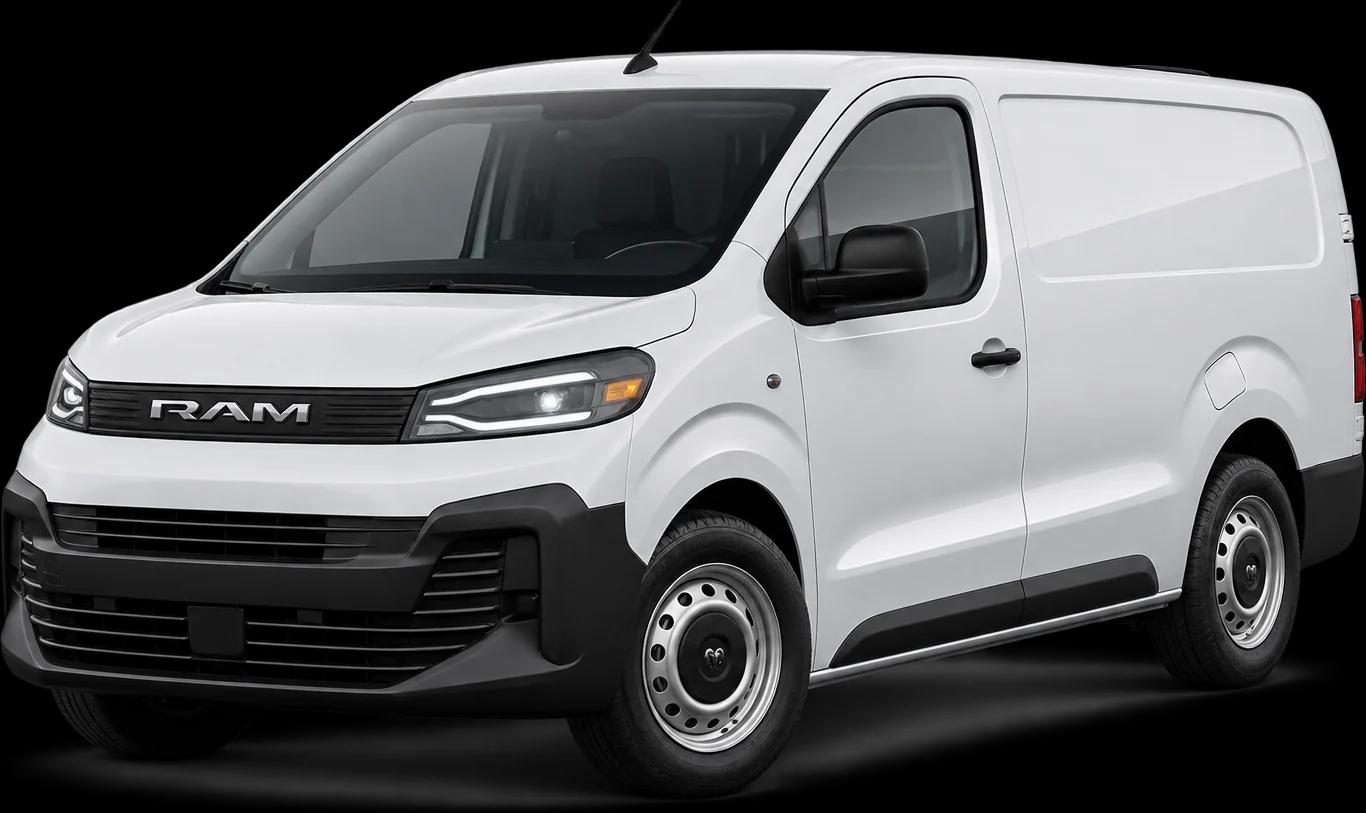
The ProMaster City is a separate, smaller van. The research data covers it through 2022, then skips to 2027, which has only a spec sheet.
| Item | ProMaster (2026) | ProMaster City (2022) | ProMaster City (2027) |
|---|---|---|---|
| Engine | 3.6L V‑6, 276 hp, 250 lb‑ft | 2.4L I‑4, 178 hp, 174 lb‑ft | 1.6L turbo I‑4, 166 hp, 221 lb‑ft |
| Transmission | 9‑speed | 9‑speed (948TE) | 8‑speed (Aisin AMN8L) |
| GVWR, lb | 8,550 to 9,350 | 5,395 | not listed |
| Payload, lb | 3,870 to 5,280 | 1,710 (wagon), 1,890 (cargo van) | 2,200, targeted |
| Curb weight, lb | 4,066 to 5,092 | 3,500 to 3,683 | not listed |
| Max trailer, lb | 5,600 to 7,500 | 1,870 to 2,000 | about 2,000, targeted |
| Wheelbase, in | 118 to 159 | 122.4 | not listed |
| Length, in | 195.4 to 250.6 | 187.1 | not listed |
| Height, in | 87.3 to 103.6 | 74.2 | not listed |
| Cargo volume | 259 to 463 cu ft | 131.7 and 101.7 cu ft max | not listed |
| Fuel tank | 24 gal | 16 gal | not listed |
| Oil with filter | 6 qt | 5.5 qt | not listed |
By subtraction, the lowest-payload ProMaster 1500 in the 2026 chart carries 1,980 lb more than the City cargo van (3,870 minus 1,890), and the smallest ProMaster cargo volume, 259 cu ft, is 127.3 cu ft above the City's 131.7. The City's payload by year moves little: cargo van 1,883 lb in 2020, 1,890 lb in 2021 and 2022, wagon 1,713 lb then 1,710 lb. The 2022 sheet lists two load-floor heights, 23.3 and 23.8 in, and the 2027 sheet lists neither dimensions nor GVWR; its payload and towing figures are labeled targeted.
The City's chart lists a cargo-van curb weight of 3,498 lb in 2020 and 2021 and 3,500 lb in 2022, and 3,682 or 3,683 lb for the wagon. Its year pages: 2020, 2021, 2022 and 2027.
How to check your own van
Payload moves with the exact body, roof and options, so start with the door-jamb label. A VIN lookup in the VIN decoder matches a van to its chart row, the spec explorer puts any two configurations side by side, and the towing page lists each year's chart. The ProMaster hub and the ProMaster City hub list every model year in the research data.